
SEO vs GEO vs AEO: The Ultimate Guide to the Three-Headed Marketing Beast
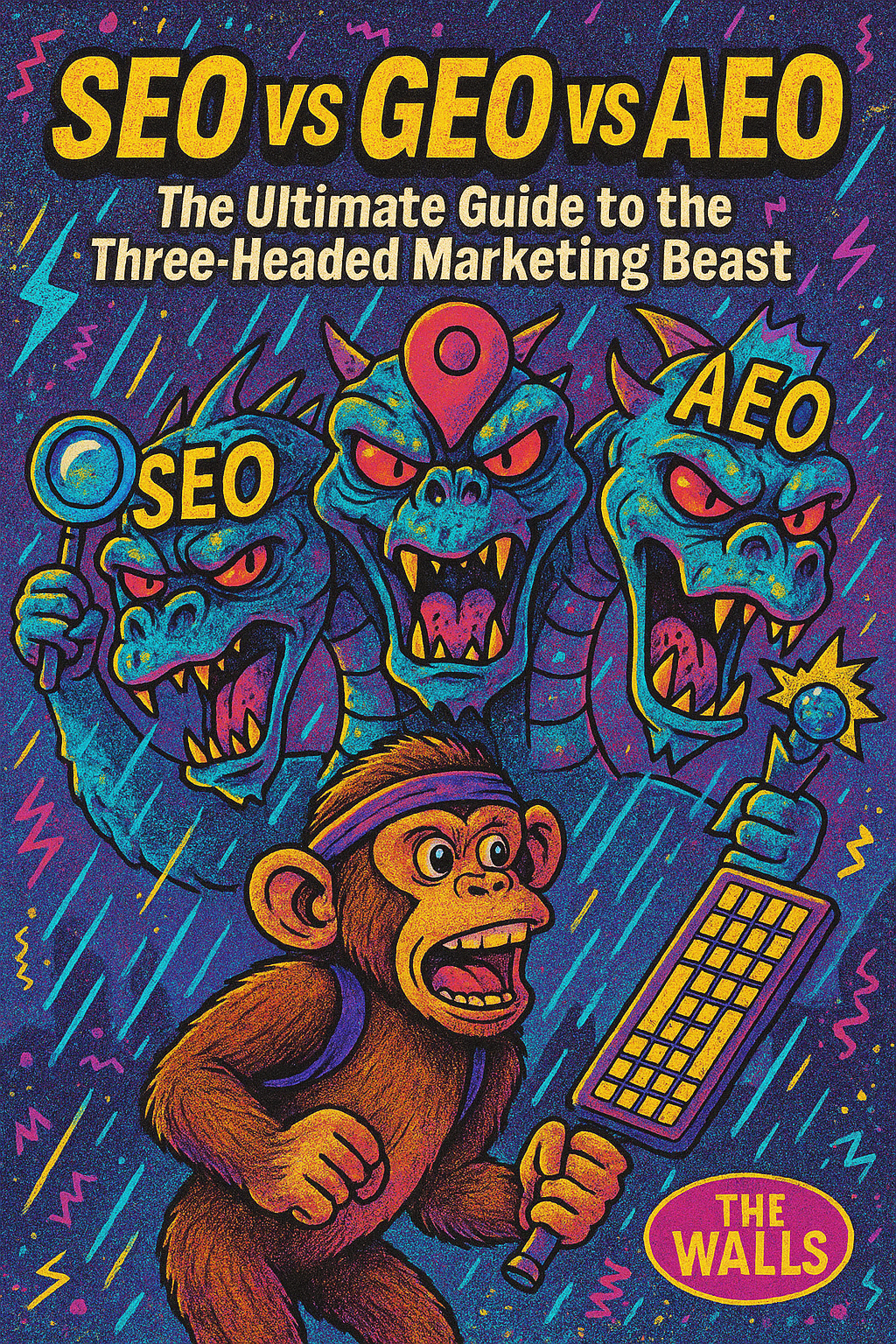
Let's get one thing straight. If you're running a business today, you've heard the acronyms: SEO, GEO, and AEO. You've probably seen them thrown around by so-called "experts" who make them sound like they're competing forces in a digital war. They're not. This isn't a battle. It's a symphony. If you're asking about SEO vs GEO vs AEO, you’re already missing the bigger picture.
The truth is, these three concepts are interconnected, and a professional strategy requires mastery of all of them. To win, you need to stop thinking about SEO vs GEO vs AEO and start thinking about how they work together to dominate search results and capture new customers.
This is your unfiltered guide to each acronym, what they mean, and how to use their combined power to build an unstoppable brand. This is a deep dive into SEO vs GEO vs AEO.
Section 1: The Grandfather - SEO (Search Engine Optimization)
Before anything else, there was SEO. Search Engine Optimization is the grand strategy of getting your website to rank higher in search results on platforms like Google, Bing, and Yahoo. The goal of traditional SEO is to increase organic, non-paid traffic by making your website more attractive to search engines. The core principles of SEO are timeless and include:
Keyword Research: Finding the words and phrases your target audience uses to find you.
On-Page SEO: Optimizing your website's content, titles, meta descriptions, and images to be more relevant to your keywords.
Technical SEO: Ensuring your website is fast, secure, mobile-friendly, and easy for search engines to crawl.
Link Building: Earning high-quality backlinks from other reputable websites to build authority.
This is the foundation. Every other marketing acronym, including our debate about SEO vs GEO vs AEO, builds upon this core concept. Without a solid SEO foundation, your efforts in GEO and AEO will fail. You cannot win the battle of SEO vs GEO vs AEO without winning at SEO first.
Section 2: The Local Champion - GEO (Geographic Optimization)
If SEO is the grand strategy, Geographic Optimization is the specialized mission. GEO is a critical component of SEO, designed specifically for local businesses. It's about ensuring your business shows up when a customer in your specific area, like San Antonio, Texas; is searching for a service you provide. When you're thinking about SEO vs GEO vs AEO, GEO is the most immediate, tangible way to get paying customers in the door.
For a local business, a focused GEO strategy is arguably more important than a broad SEO approach. Why? Because the person searching for "best coffee shop near me" is ready to buy right now. The difference between is for a local brand is that GEO turns digital presence into physical foot traffic. A strong GEO strategy includes:
Google Business Profile (GBP) Optimization: The single most crucial part of local SEO. This is your digital storefront, and it needs to be perfect.
Localized Keywords: Using city-specific keywords like "San Antonio marketing agency" in your content. This is how you win the local battle of SEO vs GEO vs AEO.
Local Citations: Listing your business on local directories like Yelp, and ensuring your name, address, and phone number (NAP) are consistent everywhere.
Geographically-Relevant Content: Creating blog posts and landing pages that specifically cater to local interests and pain points.
The core of a GEO strategy is to tell search engines that you are a relevant, authoritative entity within a specific geographic area. When you do this, you make your brand irresistible to local customers. The debate of SEO vs GEO vs AEO becomes irrelevant when you realize that GEO is simply a hyper-focused type of SEO.
Section 3: The New Frontier - AEO (Answer Engine Optimization)
Now, let's talk about the new kid on the block: Answer Engine Optimization. AEO is a modern evolution of SEO. With the rise of AI-powered search (think Google's Search Generative Experience, ChatGPT, and other conversational AI), search is no longer just about a list of blue links. It’s about a single, definitive answer. The question of SEO vs GEO vs AEO has a new dimension.
AEO is the practice of optimizing your content to be the source of truth for these AI answer engines. It's not just about ranking #1 anymore; it's about being chosen as the "featured snippet" or the direct response to a user's question. AEO requires a shift in how you think about content.
Instead of writing for a broad keyword, you need to write to answer a specific question clearly and concisely. The winner in the SEO vs GEO vs AEO debate will be the one who masters AEO because that is where search is going. The future of search isn't a list; it's a conversation. To win at AEO, you need to:
Provide Direct Answers: Start your content with the most direct, straightforward answer to a question.
Use Structured Data: Implement structured data and schema markup to help AI understand your content.
Target Conversational Keywords: Optimize for long-tail, conversational queries that users would ask a virtual assistant.
Build Authority and Trust: AI models heavily rely on trusted, authoritative sources. Your website must be a credible source to be chosen as the answer.
The old argument of SEO vs GEO vs AEO is a distraction. AEO is not replacing SEO; it is expanding it. A successful AEO strategy is built on a strong SEO foundation, and the best AEO results often come from a website with high authority and trust, the very things you build with a solid SEO plan. The SEO vs GEO vs AEO discussion is more about how they complement each other than how they compete.
The Verdict: It’s Not SEO vs GEO vs AEO. It's SEO + GEO + AEO.
The most powerful marketing strategy is one that understands the entire ecosystem. You don't have to choose between SEO vs GEO vs AEO; you must master them all.
Start with SEO: Build your foundation. Get the technical details right, and start building content and authority. Without this, your other efforts are just building on sand. A solid understanding of SEO vs GEO vs AEO begins with SEO.
Hyper-focus with GEO: Once your foundation is in place, double down on local. Use GEO to capture the highest-intent customers who are ready to walk through your door. The most common mistake in the SEO vs GEO vs AEO debate is underestimating the power of local.
Future-proof with AEO: As you build authority and create content, make sure you're optimizing it for the future of search. Structure your content to be the definitive answer. A forward-thinking approach to SEO vs GEO vs AEO means preparing for the next evolution of search.
The conversation about SEO vs GEO vs AEO is over. The conclusion is simple: you need them all. The only real question is which one you're going to master first.
Frequently Asked Questions (FAQ)
Q: What is the main difference between SEO, GEO, and AEO?
A: SEO is the overarching strategy for ranking in search engines. GEO is a specialized form of SEO focused on local results. AEO is a modern evolution of SEO, optimizing for direct answers from AI and voice assistants.
Q: How do SEO, GEO, and AEO work together?
A: They are a cohesive system. A strong SEO foundation (authority and technical health) is necessary for both GEO and AEO to be effective. GEO leverages that authority to dominate local search, while AEO uses that authority to be chosen as the definitive answer by AI platforms.
Q: Can I focus on just one of them?
A: While you can start with a focus on one, a holistic approach is best. Neglecting SEO will undermine your other efforts, and ignoring GEO or AEO means you're missing out on key opportunities to capture both local and future-proof traffic. The conversation about SEO vs GEO vs AEO is not about choosing one, but about mastering them all.
Q: What is the most important for a local business: SEO, GEO, or AEO?
A: For a local business, GEO is often the most critical for immediate, tangible results, as it directly connects you with high-intent local customers. However, a strong SEO foundation is required for an effective GEO strategy, and a modern business can't afford to ignore the growing importance of AEO.
Q: How can I measure the success of my SEO, GEO, and AEO efforts?
A: You measure success through a combination of metrics:
SEO: Organic traffic, keyword rankings, and website authority.
GEO: Google Business Profile views, clicks, and calls, as well as local map pack rankings.
AEO: Being featured as a direct answer or in "AI Overviews," which can be measured through brand mentions and click-throughs from those results.
